Recent Reviews...

Showing posts with label Julia Quinn. Show all posts

Sunday, August 28, 2022

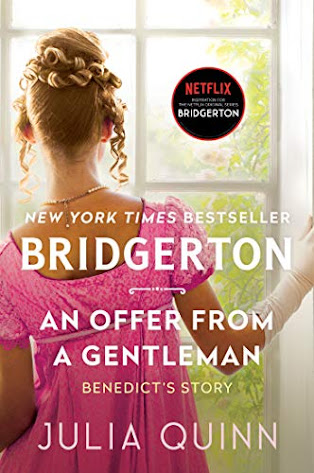
Book Review: An Offer From a Gentleman by Julia Quinn


An Offer From a Gentleman (Bridgertons #3) by Julia Quinn
Genre: Adult Fiction (Historcal Romance)
Date Published: July 1, 2001
Publisher: Avon

Sophie Beckett never dreamed she'd be able to sneak into Lady Bridgerton's famed masquerade ball—or that "Prince Charming" would be waiting there for her! Though the daughter of an earl, Sophie has been relegated to the role of servant by her disdainful stepmother. But now, spinning in the strong arms of the debonair and devastatingly handsome Benedict Bridgerton, she feels like royalty. Alas, she knows all enchantments must end when the clock strikes midnight.

Who was that extraordinary woman? Ever since that magical night, a radiant vision in silver has blinded Benedict to the attractions of any other—except, perhaps, this alluring and oddly familiar beauty dressed in housemaid's garb whom he feels compelled to rescue from a most disagreeable situation. He has sworn to find and wed his mystery miss, but this breathtaking maid makes him weak with wanting her. Yet, if he offers her his heart, will Benedict sacrifice his only chance for a fairy tale love?

An Offer from a Gentleman is the third book in the Bridgertons series by Julia Quinn. This is Benedict and Sophie's story. This was a Cinderella retelling, and it was told so well. Were the previous two books in this series retellings too? If they were, I didn't pick up on it. Anyway, Benedict is definitely more carefree than Anthony was. I truly enjoyed getting to know him better. Sophie has been dealt a bad hand at life, but leave it to a Bridgerton to come to the rescue.. literally. These two were fun. I'm not sure why Sophie kept her identity hidden for so long. I don't think she even knows, but it all worked anyway. 

The beginning brought me back to the movie, Ever After. That' still one of my favorite movies, and I really enjoyed how this story seemed to use that movie but fully grew into its own story as things progressed. This is my favorite one so far. Well see if that changes once I get to Eloise's story. I can't wait to read hers!

Everyone knew that Sophie Beckett was a bastard.

The servants all knew it. But they loved little Sophie, had loved her since she’d arrived at Penwood Park at the age of three, a small bundle wrapped in a too-big coat, left on the doorstep on a rainy July night. And because they loved her they pretended that she was exactly what the sixth Earl of Penwood said she was– the orphaned daughter of an old friend. Never mind that Sophie’s moss green eyes and dark blond hair matched the earl’s precisely. Never mind that the shape of her face looked remarkably like that of the earl’s recently deceased mother, or that her smile was an exact replica of the earl’s sister’s. No one wanted to hurt Sophie’s feelings –or risk their livelihoods– by pointing that out.

The earl, one Richard Gunningworth, never discussed Sophie or her origins, but he must have known she was his bastard. No one knew what had been in the letter the housekeeper had fished from Sophie’s pocket when she’d been discovered that rainy midnight; the earl had burned the missive mere seconds after reading it. He’d watched the paper shrivel and curl in the flames, then ordered a room made up for Sophie near the nursery. She’d remained there ever since. He called her Sophia, and she called him “my lord,” and they saw each other a few times a year, whenever the earl returned home from London, which wasn’t very often.

But perhaps most importantly, Sophie knew she was a bastard. She wasn’t entirely certain how she knew it, just that she did, and probably had her entire life. She had few memories of her life before her arrival at Penwood Manor, but she could remember a long coach journey across England, and she could remember her grandmother, coughing and wheezing and looking terribly thin, telling her she was going to live with her father. And most of all, she could remember standing on the doorstep in the rain, knowing that her grandmother was hiding in the bushes, waiting to see if Sophie was taken inside.

The earl had touched his fingers to the little girl’s chin, tipped her face up to the light, and in that moment they both knew the truth.

Everyone knew Sophie was a bastard, and no one talked about it, and they were all quite happy with this arrangement.

Until the earl decided to marry.

Sophie had been quite pleased when she’d heard the news. The housekeeper had said that the butler had said that the earl’s secretary had said that the earl planned to spend more time at Penwood Park now that he would be a family man. And while Sophie didn’t exactly miss the earl when he was gone –it was hard to miss someone who didn’t pay her much attention when even he was there– she rather thought she might miss him if she got to know him better, and if she got to know him better, maybe he wouldn’t go away so often. Plus, the upstairs maid had said that the housekeeper had said that the neighbors’ butler had said that the earl’s intended wife already had two daughters, and they were near in age to Sophie.

After seven years alone in the nursery, Sophie was delighted. Unlike the other children in the district, she was never invited to local parties and events. No one actually came out and called her a bastard– to do so was tantamount to calling the earl, who had made one declaration that Sophie was his ward and then never revisited the subject, a liar. But at the same time, the earl never made any great attempt to force Sophie’s acceptance. And so at the age of ten, Sophie’s best friends were maids and footmen, and her parents might as well have been the housekeeper and butler.

But now she was getting sisters for real.

Oh, she knew she could not call them her sisters. She knew that she would be introduced as Sophia Maria Beckett, the earl’s ward, but they would feel like sisters. And that was what really mattered.

And so, one February afternoon, Sophie found herself waiting in the great hall along with the assembled servants, watching out the window for the earl’s carriage to pull up the drive, carrying in it the new countess and her two daughters. And, of course, the earl.

“Do you think she’ll like me?” Sophie whispered to Mrs. Gibbons, the housekeeper. “The earl’s wife, I mean.”

“Of course she’ll like you, dearling,” Mrs. Gibbons whispered back. But her eyes hadn’t been as certain as her tone. The new countess might not take kindly to the presence of her husband’s by-blow.

“And I’ll take lessons with her daughters?”

“No point in having you take your lessons separately.”

Sophie nodded thoughtfully, then started to squirm when she saw the carriage rolling up the drive. “They’re here!” she whispered urgently.

Mrs. Gibbons reached out to pat her on the head, but Sophie had already dashed off to the window, practically pressing her face up to the glass.

The earl stepped down first, then reached in and helped down two young girls. They were dressed in matching black coats. One wore a pink ribbon in her hair; the other yellow. Then, as the two girls stepped aside, the earl reached up to help one last person from the carriage.

Sophie’s breath caught in her throat as she waited for the new countess to emerge. Her little fingers crossed and a single whisper of, “Please,” whispered over her lips.

Please let her love me.

Maybe if the countess loved her, then the earl would love her as well, and maybe, even if he didn’t actually call her daughter, he’d treat her as one, and they’d be a family truly.

As Sophie watched through the window, the new countess stepped down from the carriage, her every movement so graceful and pure that Sophie was reminded of the delicate lark that occasionally came to splash in the birdbath in the garden. Even the countess’s hat was adorned by a long feather, its turquoise plume glittering in the hard winter sun.

“She’s beautiful,” Sophie whispered. She darted a quick look back at Mrs. Gibbons to gauge her reaction, but the housekeeper was standing at strict attention, eyes straight ahead, waiting for the earl to bring his new family inside for introductions.

Sophie gulped, not exactly certain where she was meant to stand. Everyone else seemed to have a designated place. The servants were lined up according to rank, from the butler right down to the lowliest scullery maid. Even the dogs were sitting dutifully in the corner, their leads held tight by the Keeper of the Hounds.

But Sophie was rootless. If she were truly the daughter of the house, she’d be standing with her governess, awaiting the new countess. If she were truly the earl’s ward, she’d be in much the same place. But Miss Timmons had caught a head cold and refused to leave the nursery and come downstairs. None of the servants believed for a second that the governess was truly ill. She’d been fine the night before, but no one blamed her for the deception. Sophie was, after all, the earl’s bastard, and no one wanted to be the one to offer potential insult to the new countess by introducing her to her husband’s by-blow.

And the countess would have to be blind, stupid, or both not to realize in an instant that Sophie was something more than the earl’s ward.

Suddenly overcome with shyness, Sophie shrank into a corner as two footmen threw open the front doors with a flourish. The two girls entered first, then stepped to the side as the earl led the countess in. The earl introduced the countess and her daughters to the butler, and the butler introduced them to the servants.

And Sophie waited.

The butler presented the footmen, the chef, the housekeeper, the grooms.

And Sophie waited.

He presented the kitchen maids, the upstairs maids, the scullery maids.

And Sophie waited.

And then finally the butler –Rumsey was his name– presented the lowliest of the lowest of maids, a scullery girl named Dulcie who had been hired a mere week earlier. The earl nodded and murmured his thanks, and Sophie was still waiting, completely unsure of what to do.

So she cleared her throat and stepped forward, a nervous smile on her face. She didn’t spend much time with the earl, but she was trotted out before him whenever he visited Penwood Park, and he always gave her a few minutes of his time, asking about her lessons before shooing her back up to the nursery.

Surely he’d still want to know how her studies were progressing, even now that he’d married. Surely he’d want to know that she’d mastered the science of multiplying fractions, and that Miss Timmons had recently declared her French accent, “perfection.”

But he was busy saying something to the countess’s daughters, and he didn’t hear her. Sophie cleared her throat again, this time more loudly, and said, “My lord?” in a voice that came out a bit more squeaky than she’d intended.

The earl turned around. “Ah, Sophia,” he murmured, “I didn’t realize you were in the hall.”

Sophie beamed. He hadn’t been ignoring her, after all.

“And who might this be?” the countess asked, stepping forward to get a better look.

“My ward,” the earl replied. “Miss Sophia Beckett.”

The countess speared Sophie with an assessing look, then her eyes narrowed.

And narrowed.

And narrowed some more.

“I see,” she said.

And everyone in the room knew instantly that she did see.

“Rosamund,” the countess said, turning to her two girls, “Posy, come with me.”

The girls moved immediately to their mother’s side. Sophie hazarded a smile in their direction. The smaller one smiled back, but the older one, whose hair was the color of spun gold, took her cue from her mother, pointed her nose in the air, and looked firmly away.

Sophie gulped and smiled again at the friendly girl, but this time the little girl chewed on her lower lip in indecision and then cast her eyes toward the floor.

The countess turned her back on Sophie and said to the earl, “I assume you have had rooms prepared for Rosamund and Posy.”

He nodded. “Near the nursery. Right next to Sophie.”

There was a long silence, and then the countess must have decided that certain battles should not be conducted before the servants, because all she said was, “I would like to go upstairs now.”

And she left, taking the earl and her daughters along with her.

Sophie watched the new family walk up the stairs and then, as they disappeared onto the landing, she turned to Mrs. Gibbons and asked, “Do you think I should go up to help? I could show the girls the nursery.”

Mrs. Gibbons shook her head. “They looked tired,” she lied. “I’m sure they’ll be needing a nap.”

Sophie frowned. She’d been told that Rosamund was eleven and Posy was ten. Surely that was a bit old for taking naps.

Mrs. Gibbons patted her on the back. “Why don’t you come with me? I could use a bit of company, and Cook told me that she just made a fresh batch of shortbread. I think it’s still warm.”

Sophie nodded and followed her out of the hall. She’d have plenty of time that evening to get to know the two girls. She’d show them the nursery, and then they’d become friends, and before long they’d be as sisters.

Sophie smiled. It would be glorious to have sisters.

Check out my review of other books by this author.

author
#1 New York Times bestselling author Julia Quinn loves to dispel the myth that smart women don't read (or write) romance, and and if you watch reruns of the game show The Weakest Link you might just catch her winning the $79,000 jackpot. She displayed a decided lack of knowledge about baseball, country music, and plush toys, but she is proud to say that she aced all things British and literary, answered all of her history and geography questions correctly, and knew that there was a Da Vinci long before there was a code.

A graduate of Harvard and Radcliffe Colleges, Ms. Quinn is one of only sixteen members of Romance Writers of America’s Hall of Fame. Her books have been translated into 32 languages, and she lives with her family in the Pacific Northwest.


To learn more about Julia Quinn and her books, visit her website. You can also find her on GoodreadsFacebookInstagramBookBub, and Pinterest.

Buy this book at:

Friday, July 9, 2021

Book Review: The Viscount Who Loved Me by Julia Quinn


The Viscount Who Loved Me (Bridgertons #2) by Julia Quinn
Genre: Adult Fiction (Historcal Romance)
Date Published: December 5, 2000
Publisher: Avon

1814 promises to be another eventful season, but not, this author believes, for Anthony Bridgerton, London's most elusive bachelor, who has shown no indication that he plans to marry.
And in truth, why should he? When it comes to playing the consummate rake, nobody does it better...
—Lady Whistledown's Society Papers, April 1814

But this time, the gossip columnists have it wrong. Anthony Bridgerton hasn't just decided to marry—he's even chosen a wife! The only obstacle is his intended's older sister, Kate Sheffield—the most meddlesome woman ever to grace a London ballroom. The spirited schemer is driving Anthony mad with her determination to stop the betrothal, but when he closes his eyes at night, Kate is the woman haunting his increasingly erotic dreams...

Contrary to popular belief, Kate is quite sure that reformed rakes do not make the best husbands—and Anthony Bridgerton is the most wicked rogue of them all. Kate is determined to protect her sister—but she fears her own heart is vulnerable. And when Anthony's lips touch hers, she's suddenly afraid she might not be able to resist the reprehensible rake herself...


The Viscount Who Loved Me is the second book in the Bridgerton series by Julia Quinn. This is Anthony's story. He's definitely a stubborn little bugger. Whoever he married was always going to have her hands and wits full with this one. I think he's worth it though. He's very intense.. in everything. When he feels, he feels very deeply. He hides those feels very well though, even from himself. He definitely needed a Kate to come along and disrupt the plans he thought he had for his life. I loved how these two bickered. It was like they were a married couple from the start. Very cute. It seemed to me like everyone around them knew too, even though no one really said it out loud. I enjoyed this one quite a bit.

Anthony Bridgerton had always known he would die young.

Oh, not as a child. Young Anthony had never had cause to ponder his own mortality. His early years had been a young boy’s perfection, right from the very day of his birth.

It was true that Anthony was the heir to an ancient and wealthy viscountcy, but unlike most other aristocratic couples, Lord and Lady Bridgerton were very much in love, and they saw their son’s birth not as the arrival of an heir, but rather that of a child.

And so there were no parties, no fetes, no celebration other than that of mother and father staring in wonderment at their new son.

The Bridgertons were young parents— Edmund barely twenty and Violet just eighteen, but they were sensible and they were strong, and they loved their son with a fierceness and devotion that was rarely seen in their social circles. Much to her own mother’s horror, Violet insisted upon nursing the boy herself, and Edmund never subscribed to the prevailing attitude that fathers should neither see nor hear their children. He took the infant on long hikes across the fields of Kent, spoke to him of philosophy and poetry before he could possibly understand the words, and told him a bedtime story every night.

Because the viscount and viscountess were so young and so very much in love, it came as no surprise to anyone when, just two years after Anthony’s birth, he was joined by a younger brother, christened Benedict. Edmund immediately adjusted his daily routine to take two sons on his hikes, and he spent a week holed up in the stables, working with his leathersmith to devise a special pack that would hold Anthony on the his back while he held the baby Benedict in his arms.

They walked across fields and streams, and he told them of wondrous things, of perfect flowers and clear blue skies, of knights in shining armor and damsels in distress. Violet used to laugh when they returned, all windblown and sun-kissed, and Edmund would say, “See? Here is our damsel in distress. Clearly we must save her.” And Anthony would throw himself into his mother’s arms, giggling as he swore he’d protect her from the fire-breathing dragon they’d seen just two miles down the road in the village.

“Two miles down the road in the village?” Violet would breathe, keeping her voice carefully laden with horror. “Heaven above, what would I do without three strong men to protect me?”

“Benedict’s a baby,” Anthony would reply.

“But he’ll grow up,” she’d always say, tousling his hair, “just as you did. And just as you still will.”

Edmund always treated his children with equal affection and devotion, but late at night, when Anthony cradled the Bridgerton pocket watch to his chest (given to him on his eighth birthday by his father, who had received it on his eighth birthday from his father) he liked to think that his relationship with his father was just a little bit special. Not because Edmund loved him best; by that point the Bridgerton siblings numbered four (Colin and Daphne had arrived fairly close together) and Anthony knew very well that all the children were well loved.

No, Anthony liked to think that his relationship with his father was special simply because he’d known him the longest. After all, no matter how long Benedict had known their father, Anthony would always have two years on him. And six on Colin. And as for Daphne, well, beside the fact that she was a girl (the horror!) she’d known Father a full eight years less than he had and, he liked to remind himself, always would.

Edmund Bridgerton was, quite simply, the very center of Anthony’s world. He was tall, his shoulders were broad, and he could ride a horse as if he’d been born in the saddle. He always knew the answers to arithmetic questions (even when the tutor didn’t), he saw no reason why his sons should not have a tree house (and then he went and built it himself), and his laugh was the sort that warmed a body from the inside out.

Edmund taught Anthony how to ride. He taught Anthony how to shoot. He taught him to swim. He took him off to Eton himself, rather than sending him in a carriage with servants, as most of Anthony’s future friends arrived, and when he saw Anthony glancing nervously about the school that would become his new home, he had a heart-to-heart talk with his eldest son, assuring him that everything would be all right.

And it was. Anthony knew it would be. His father, after all, never lied.

Anthony loved his mother. Hell, he’d probably bite off his own arm if it meant keeping her safe and well. But growing up, everything he did, every accomplishment, every goal, every single hope and dream —it was all for his father. And then one day, everything changed. It was funny, he reflected later, how one’s life could alter in an instant, how one minute everything could be a certain way, and the next it’s simply… not.

It happened when Anthony was eighteen, home for the summer and preparing for his first year at Oxford. He was to belong to All Souls College, as his father had before him, and his life was as bright and dazzling as any eighteen-year-old had a right to enjoy. He had discovered women, and perhaps more splendidly, they had discovered him, and he even managed not to roll his eyes when he passed his mother in the hall—pregnant with her eighth child! Anthony thought it a bit unseemly that his parents were still happily reproducing, but he kept his opinions to himself.

Who was he to doubt Edmund’s wisdom? Maybe he, too, would want more children at the advanced age of thirty-eight.

When Anthony found out, it was late afternoon. He was returning from a long and bruising ride with Benedict and had just pushed through the front door of Aubrey Hall, the ancestral home of the Bridgertons, when he saw his ten-year-old sister, sitting on the floor. Benedict was still in the stables, having lost some silly bet with Anthony, the terms of which required him to rub down both horses.

Anthony stopped short when he saw Daphne. It was odd enough that his sister was sitting in the middle of the floor in the main hall. It was even more odd that she was crying.

Daphne never cried.

“Daff,” he said hesitantly, too young to know what to do with a crying female and wondering if he’d ever learn, “what–”

But before he could finish his question, Daphne lifted her head, and the shattering heartbreak in her large, brown eyes cut through him like a knife. He stumbled back a step, knowing something was wrong, terribly wrong.

“He’s dead,” Daphne whispered. “Papa is dead.”

For a moment Anthony was sure he’d misheard. His father couldn’t be dead. Other people died young, like Uncle Hugo, but Uncle Hugo had been small and frail. Well, at least smaller and frailer than Edmund.

“You’re wrong,” he told Daphne. “You must be wrong.”

She shook her head. “Eloise told me. He was… It was…”

Anthony knew he shouldn’t shake his sister while she sobbed, but he couldn’t help himself. “It was what, Daphne?”

“A bee,” she whispered. “He was stung by a bee.”

For a moment Anthony could do nothing but stare at her. Finally, his voice hoarse and barely recognizable, he said, “A man doesn’t die from a bee sting, Daphne.”

She said nothing, just sat there on the floor, her throat working convulsively as she tried to control her tears.

“He’s been stung before,” Anthony added, his voice rising in volume. “I was with him. We were both stung. We came across a nest. I was stung on the shoulder.” Unbidden, his hand rose to touch the spot where he’d been stung so many years before. In a whisper he added, “He on his arm.”

Daphne just stared at him with an eerily blank expression.

“He was fine,” Anthony insisted. He could hear the panic in his voice and knew he was frightening his sister, but he was powerless to control it. “A man can’t die from a bee sting!”

Daphne shook her head, her dark eyes suddenly looking about a hundred years old. “It was a bee,” she said in a hollow voice. “Eloise saw it. One minute he was just standing there, and the next he was… he was…”

Anthony felt something very strange building within him, as if his muscles were about to jump through his skin. “The next he was what, Daphne?”

“Gone.” She looked bewildered by the word, as bewildered as he felt.

Anthony left Daphne sitting in the hall and took the stairs three at a time up to his parents’ bedchamber. Surely his father wasn’t dead. A man couldn’t die from a bee sting. It was impossible. Utterly mad. Edmund Bridgerton was young, he was strong. He was tall, his shoulders were broad, his muscles were powerful, and by God, no insignificant honey bee could have felled him.

But when Anthony reached the upstairs hall, he could tell by the utter and complete silence of the dozen or so hovering servants that the situation was grim.

And their pitying faces… For the rest of his life he’d be haunted by those pitying faces.

He’d thought he’d have to push his way into his parents’ room, but the servants parted as if drops in the Red Sea, and when Anthony pushed open the door, he knew.

His mother was sitting on the edge of the bed, not weeping, not even making a sound, just holding his father’s hand as she rocked slowly back and forth.

His father was still. Still as…

Anthony didn’t even want to think the word.

“Mama?” he choked out. He hadn’t called her that for years; she’d been “Mother” since he’d left for Eton.

She turned, slowly, as if hearing his voice through a long, long tunnel.

“What happened?” he whispered.

She shook her head, her eyes hopelessly far away. “I don’t know,” she said. Her lips remained parted by an inch or so, as if she’d meant to say something more but then forgotten to do it.

Anthony took a step forward, his movements awkward and jerky.

“He’s gone,” Violet finally whispered. “He’s gone and I… Oh, God, I…” She placed a hand on her belly, full and round with child. “I told him—Oh, Anthony, I told him–”

She looked as if she might shatter from the inside out. Anthony choked back the tears that were burning his eyes and stinging his throat and moved to her side. “It’s all right, Mama,” he said.

But he knew it wasn’t all right. “I told him this had to be our last,” she gasped, sobbing onto his shoulder.

“I told him I couldn’t carry another, and we’d have to be careful, and… Oh, God, Anthony, what I’d do to have him here and give him another child. I don’t understand. I just don’t understand…”

Anthony held her while she cried. He said nothing; it seemed useless to try to make any words fit the devastation in his heart.

He didn’t understand, either.

The doctors came later that evening and pronounced themselves baffled. They’d heard of such things before, but never in one so young and strong. He was so vital, so powerful; nobody could have known. It was true that the viscount’s younger brother Hugo had died quite suddenly the year before, but such things did not necessarily run in families, and besides, even though Hugo had died by himself out of doors, no one had noticed a bee sting on his skin.

Then again, nobody had looked.

Nobody could have known, the doctors kept saying, over and over until Anthony wanted to strangle them all. Eventually he got them out of the house, and he put his mother to bed. They had to move her into a spare bedroom; she grew agitated at the thought of sleeping in the bed she’d shared for so many years with Edmund. Anthony managed to send his six brothers and sisters to bed as well, telling them that they’d all talk in the morning, that everything would be well, and he would take care of them as their father would have wanted.

Then he walked into the room where his father’s body still lay and looked at him. He looked at him and looked at him, staring at him for hours, barely blinking.

And when he left the room, he left with a new vision of his own life, and new knowledge about his own mortality.

Edmund Bridgerton had died at the age of thirty-eight. And Anthony simply couldn’t imagine ever surpassing his father in any way, even in years.
 

Check out my review of other books by this author.

author
#1 New York Times bestselling author Julia Quinn loves to dispel the myth that smart women don't read (or write) romance, and and if you watch reruns of the game show The Weakest Link you might just catch her winning the $79,000 jackpot. She displayed a decided lack of knowledge about baseball, country music, and plush toys, but she is proud to say that she aced all things British and literary, answered all of her history and geography questions correctly, and knew that there was a Da Vinci long before there was a code.

A graduate of Harvard and Radcliffe Colleges, Ms. Quinn is one of only sixteen members of Romance Writers of America’s Hall of Fame. Her books have been translated into 32 languages, and she lives with her family in the Pacific Northwest.

The Bridgertons, her popular series of historical romance, is currently in production by Shondaland as a Netflix original series starring Julie Andrews, Phoebe Dynevor, and Rége-Jean Page.

To learn more about Julia Quinn and her books, visit her website. You can also find her on GoodreadsFacebookInstagramBookBub, and Pinterest.

Buy this book at:

Saturday, March 6, 2021

Book Review: The Duke and I by Julia Quinn


The Duke and I (Bridgertons #1) by Julia Quinn
Genre: Adult Fiction (Historcal Romance)
Date Published:  January 5, 2000
Publisher: Avon

The Duke and I is a romance set in the Regency era.

In the ballrooms and drawing rooms of Regency London, rules abound. From their earliest days, children of aristocrats learn how to address an earl and curtsey before a prince—while other dictates of the ton are unspoken yet universally understood. A proper duke should be imperious and aloof. A young, marriageable lady should be amiable… but not too amiable.

Daphne Bridgerton has always failed at the latter. The fourth of eight siblings in her close-knit family, she has formed friendships with the most eligible young men in London. Everyone likes Daphne for her kindness and wit. But no one truly desires her. She is simply too deuced honest for that, too unwilling to play the romantic games that captivate gentlemen.

Amiability is not a characteristic shared by Simon Basset, Duke of Hastings. Recently returned to England from abroad, he intends to shun both marriage and society—just as his callous father shunned Simon throughout his painful childhood. Yet an encounter with his best friend’s sister offers another option. If Daphne agrees to a fake courtship, Simon can deter the mamas who parade their daughters before him. Daphne, meanwhile, will see her prospects and her reputation soar.

The plan works like a charm—at first. But amid the glittering, gossipy, cut-throat world of London’s elite, there is only one certainty: love ignores every rule...

The Duke and I is the first book in the Bridgerton series by Julia Quinn. This was a cute and charming story, and I loved every minute of it... aside from one part. That part alone is responsible for the three star rating... and maybe I should have rated it lower, because that part really ruined my enjoyment of their story. I'd seen the series on TV before reading the book, and I thought surely that's not really how the book played out. I figured they just added it because it's TV, and they always add stupid stuff, but no. It was in the book too. There were any number of ways that moment could have gone with the same result. It made me not like Daphne at all. No means no Daphne. No means no!

I enjoyed Simon. Poor guy has a lot of baggage, but he really came a long way on so many levels. With that being said, their relationship... once they start to sort of really have one is full of steam and chemistry, but there's also a big lie on Simon's end which leads to the whole Daphne ordeal. You need trust and respect in relationships. This one has neither. So, it makes me wonder.. how can a relationship like this really have a happy ending? I don't think it would. You don't see the supporting characters as much in the book as you do in the TV series, so I missed them a little, but I know I'll see more as I read the rest of the series. Yes, I'll probably read the rest of the series, because I want to know what happens in everyone else's stories, but I'll be reading them through the library rather than buying them.

The birth of Simon Arthur Henry Fitzranulph Basset, Earl Clyvedon, was met with great celebration. Church bells rang for hours, champagne flowed freely through the gargantuan castle that the newborn would call home, and the entire village of Clyvedon quit work to partake of the feast and holiday ordered by the young earl’s father.

This, the baker said to the blacksmith, was no ordinary baby.

For Simon Arthur Henry Fitzranulph Basset would not spend his life as Earl Clyvedon. That was a mere courtesy title. Simon Arthur Henry Fitzranulph Basset — the baby who possessed more names than any baby could possibly need — was the heir to one of England’s oldest and richest dukedoms. And his father, the ninth Duke of Hastings, had waited years for this moment.

As he stood in the hall outside his wife’s confinement room, cradling the squalling infant, the duke’s heart burst with pride. Already several years past forty, he had watched his cronies — dukes and earls, all — beget heir after heir. Some had had to suffer through a few daughters before siring a precious son, but in the end, they’d all been assured that their lines would continue, that their blood would pass forward into the next generation of England’s elite.

But not the Duke of Hastings. Though his wife had managed to conceive five times in the fifteen years of their marriage, only twice had she carried to full term, and both of those infants had been stillborn. After the fifth pregnancy, which had ended with a bloody miscarriage in the fifth month, surgeons and physicians alike had warned their graces that they absolutely must not make another attempt to have a child. The duchess’s very life was in danger. She was too frail, too weak, and perhaps, they said gently, too old. The duke was simply going to have to reconcile himself to the fact that the dukedom would pass out of the Basset family.

But the duchess, God bless her, knew her role in life, and after a six-month recuperative period, she opened the connecting door between their bedrooms, and the duke once again commenced his quest for a son.

Five months later, the duchess informed the duke that she had conceived. The duke’s immediate elation was tempered by his grim determination that nothing —absolutely nothing— would cause this pregnancy to go awry. The duchess was confined to her bed the minute it was realized that she’d missed her monthly courses. A physician was brought in to visit her every day, and halfway through the pregnancy, the duke located the most respected doctor in London and paid him a king’s ransom to temporarily abandon his practice and take up residence at Clyvedon Castle.

The duke was taking no chances this time. He would have a son, and the dukedom would remain in Basset hands.

The duchess experienced pains a month early, and pillows were tucked under her hips. Gravity might keep the babe inside, Dr. Stubbs explained. The duke thought that a sound argument, and, when the doctor had retired for the evening, placed yet another pillow under his wife, raising her to a twenty degree angle. She remained that way for a month.

And then finally, the moment of truth arrived. The household prayed for the duke, who so wanted an heir, and a few remembered to pray for the duchess, who had grown thin and frail even as her belly had grown round and wide. They tried not to be too hopeful — after all, the duchess had already delivered and buried two babes. And even if she did manage to safely deliver a child, it could be, well, a girl.

As the duchess’s screams grew louder and more frequent, the duke shoved his way into her chamber, ignoring the protests of the doctor, the midwife, and her grace’s maid. It was a bloody mess, but the duke was determined to be present when the babe’s sex was revealed. The head appeared, then the shoulders.

All leaned forward to watch as the duchess strained and pushed, and then…

And then the duke knew that there was a God, and He smiled on the Bassets. He allowed the midwife one minute to clean the babe, then took the little boy into his arms and marched into the great hall to show him off.

“I have a son!” he boomed. “A perfect little son!”

And while the servants cheered and wept with relief, the duke looked down upon the tiny little earl and said, “You are perfect. You are a Basset. You are mine.”

The duke wanted to take the boy outside to prove to everyone that he had finally sired a healthy male child, but there was a slight chill in the early April air, so he allowed the midwife to take the babe back to his mother. The duke mounted one of his prized geldings and rode off to celebrate, shouting his good fortune to all who would listen.Meanwhile, the duchess, who had been bleeding steadily since the birth, slipped into unconsciousness, and then finally just slipped away.


Check out my review of other books by this author.

author
#1 New York Times bestselling author Julia Quinn loves to dispel the myth that smart women don't read (or write) romance, and and if you watch reruns of the game show The Weakest Link you might just catch her winning the $79,000 jackpot. She displayed a decided lack of knowledge about baseball, country music, and plush toys, but she is proud to say that she aced all things British and literary, answered all of her history and geography questions correctly, and knew that there was a Da Vinci long before there was a code.

A graduate of Harvard and Radcliffe Colleges, Ms. Quinn is one of only sixteen members of Romance Writers of America’s Hall of Fame. Her books have been translated into 32 languages, and she lives with her family in the Pacific Northwest.

The Bridgertons, her popular series of historical romance, is currently in production by Shondaland as a Netflix original series starring Julie Andrews, Phoebe Dynevor, and Rége-Jean Page.

To learn more about Julia Quinn and her books, visit her website. You can also find her on GoodreadsFacebookInstagramBookBub, and Pinterest.

Buy this book at:

Saturday, November 7, 2020

Book Review: The Other Miss Bridgerton by Julia Quinn


The Other Miss Bridgerton (Rokesbys #3) by Julia Quinn
Genre: Adult Fiction (Historical Romance)
Date Published: November 20, 2018
Publisher: Avon

She was in the wrong place...

Fiercely independent and adventurous, Poppy Bridgerton will only wed a suitor whose keen intellect and interests match her own. Sadly, none of the fools from her London season qualify. While visiting a friend on the Dorset coast, Poppy is pleasantly surprised to discover a smugglers' hideaway tucked inside a cave. But her delight turns to dismay when two pirates kidnap her and take her aboard a ship, leaving her bound and gagged on the captain's bed…

He found her at the wrong time...

Known to society as a rascal and reckless privateer, Captain Andrew James Rokesby actually transports essential goods and documents for the British government. Setting sail on a time-sensitive voyage to Portugal, he's stunned to find a woman waiting for him in his cabin. Surely, his imagination is getting the better of him. But no, she is very real—and his duty to the Crown means he's stuck with her.

Can two wrongs make the most perfect right?

When Andrew learns that she is a Bridgerton, he knows he will likely have to wed her to avert a scandal—though Poppy has no idea that he is the son of an earl and neighbor to her aristocratic cousins in Kent. On the high seas, their war of words soon gives way to an intoxicating passion. But when Andrew's secret is revealed, will his declaration of love be enough to capture her heart…? 

The Other Miss Bridgerton is the third book in The Rokesbys series by Julia Quinn. I haven't read the previous books in this series yet, but I feel like this one stood on its own just fine. Poppy and Andrew were fun characters who didn't care too much for each other at first. I've seen some reviews say she developed Stockholm Syndrome, but Andrew is never the bad guy in this story. This is not a spoiler. because you learn this early on and so does Poppy. For me, Poppy is getting the adventure she always wanted, and is embracing it the best she can. Aside from a little danger towards the end, it's pretty smooth sailing. It was a fast read, and I enjoyed it quite a bit.

Early summer 1786

For a young woman who had grown up on an island, in Somerset to be precise, Poppy Bridgerton had spent remarkably little time at the coast.

She was not unfamiliar with water. There was a lake near her family’s home, and Poppy’s parents had insisted that all their children learn to swim. Or perhaps more accurately, they had insisted that all their sons learn to swim. Poppy, the sole daughter of the bunch, took umbrage at the notion that she would be the only Bridgerton to die in a shipwreck and said as much to her parents –in precisely those words– just before she marched alongside her four brothers to the water’s edge and hurled herself in.


She’d learned faster than three out of four of her brothers (it wasn’t fair to compare her to the eldest; of course he’d catch on more quickly), and to this day she was, in her opinion, the strongest swimmer in the family. That she might have achieved this goal as much out of spite as natural ability was irrelevant. It was important to learn how to swim. She would have done so even if her parents hadn’t originally told her to wait patiently on the grass.

Probably.

But there would be no swimming today. This was the ocean, or at least the channel, and the chilly, bitter water was nothing like the placid lake at home. Poppy might be contrary, but she wasn’t stupid. And alone as she was, she had nothing to prove.

Besides, she was having far too good a time exploring the beach. The soft give of the sand beneath her feet, the tang of the saltwater air–they were as exotic to her as if she’d been dropped into Africa.

Well, maybe not, Poppy thought as she nibbled on a piece of the very familiar-tasting English cheese she’d brought along on her hike. But still and all, it was new, and it was a change, and that had to count for something.

Especially now, with the rest of her life the same as it ever was.

It was nearly July, and Poppy’s second London season –compliments of her aristocratic aunt, Lady Bridgerton– had recently drawn to a close. Poppy had found herself ending the season much as she’d begun it– unmarried and unattached.

And a little bored.

She supposed she could have remained in London for the last dregs of the social whirl, hoping that she might actually meet someone she hadn’t met before (unlikely). She could have accepted her aunt’s invitation to rusticate in Kent, on the off chance that she might actually like one of the unmarried gentlemen who just happened to be invited for dinner (even less likely). But of course this would have required that she grit her teeth and attempt to hold her tongue when Aunt Alexandra wanted to know what was wrong with the latest offering (the least likely of all.)

Her choices had been dull and duller, but thankfully she’d been saved by her dear childhood friend Elizabeth, who had moved to Charmouth several years earlier with her husband, the affable and bookish George Armitage.

George, however, had been called to Northumberland for some urgent family matter, the details of which Poppy had never quite got straight, and Elizabeth had been left alone at her seaside house, six and a half months with child. Bored and confined, she’d invited Poppy to come for an extended visit, and Poppy had happily accepted. It would be like old times for the two friends.

Poppy popped another bite of cheese into her mouth. Well, except for the massive size of Elizabeth’s belly. That was new.

It meant Elizabeth couldn’t accompany her on her daily jaunts to the shore, but that was no matter. Poppy knew her reputation had never included the word shy, but conversational nature notwithstanding, she rather enjoyed her own company. And after months and months of making small talk in London, it felt rather nice to clear her head with the sharp sea air.

She’d been trying to take a different route each day, and she had been delighted to discover a small network of caves about halfway between Charmouth and Lyme Regis, tucked away where the foamy waves lapped the shore. Most filled with water when the tide was in, but after surveying the landscape, Poppy was convinced that there had to exist a few that remained dry, and she was determined to find one.

Just because of the challenge, of course. Not because she had any need of a perpetually dry cave in Charmouth, Dorset, England.

Great Britain, Europe, the World.

One really had to take one’s challenges where one could, given that she was in Charmouth, Dorset, England, and that seemed a decidedly small corner of the world, indeed.

Finishing the last bites of her lunch, she squinted up toward the rocks. The sun was to her back, but the day was bright enough to make her wish for a parasol, or, at the very least, a large shady tree. It was gorgeously warm, too, and she’d left her redingote back at the house. Even her fichu, which she’d worn to protect her skin, was starting to get itchy and hot across her chest.

But she wasn’t going to turn back now. She’d not come this far before, and in fact had only made it to this point after convincing Elizabeth’s plumpish maid, who’d been drafted as her chaperone/companion, to remain behind in town.

“Think of it as an additional afternoon off,” Poppy had said with a winning smile.

“I don’t know.” Mary’s expression was doubtful. “Mrs. Armitage was quite clear that–”

“Mrs. Armitage hasn’t had a clear thought since finding herself with child,” Poppy cut in, sending Elizabeth a silent apology. “It’s like that for all women, I’m told,” she added, trying to get the maid’s mind off the subject at hand, namely, Poppy’s chaperonage, or lack thereof.

“Well, that’s certainly true,” Mary said, tilting her head slightly to the side. “When my brother’s wife had her boys, I never could get a sensible word out of her.”

“That’s it exactly!” Poppy exclaimed. “Elizabeth knows that I will be perfectly fine on my own. I’m no spring miss, after all. Hopelessly on the shelf, they say.”

As Mary attempted to assure her that that was most certainly not the case, Poppy added, “I’m only going for an easy little stroll by the shore. You know that. You came with me yesterday.”

“And the day before that,” Mary said with a sigh, clearly not relishing the prospect of another afternoon of exertion.

“And the day before that as well,” Poppy pointed out. “And what, all week before that?”

Mary nodded glumly.

Poppy didn’t smile. She was far too good for that. But success was clearly right around the corner.

Literally.

“Here,” she said, steering the maid toward a cozy tea shop, “why don’t you sit down and have a rest? Heaven knows you deserve it. I’ve quite run you ragged, haven’t I?”

“You’ve been nothing but kind, Miss Bridgerton,” Mary said quickly.

“Kind and exhausting,” Poppy said, patting Mary’s hand as she opened the tea room door. “You work so hard. You deserve a few minutes for yourself.”

And so, once Poppy had paid for a pot of tea and a plate of biscuits, she’d made her escape –two of the aforementioned biscuits in her pocket– and now she was wonderfully, blessedly on her own.

If only there were ladies’ shoes that were suitable for climbing across rocks. Her little boots were quite the most practical made for women, but they didn’t compare in durability with the sort that sat in her brothers’ wardrobes. She took great care to watch her steps, lest she turn an ankle. This area of the beach did not receive much foot traffic, so if she hurt herself, heaven only knew how long it would take for someone to come after her.

She whistled as she walked, enjoying the opportunity to engage in such uncouth behavior (wouldn’t her mama be horrified at the sound!), and then decided to compound the transgression by switching to a tune whose words were not suitable for female ears.

“Oh, the barmaid went down to the oh-oh-oh-ocean,” she sang happily, “with an eye toward getting her– What’s this?”

She stopped, peering at a strange formation in the rocks off to her right. A cave. It had to be. And far enough from the water’s edge that it wouldn’t flood in high tide.

“Me secret hideaway, mateys,” she said, winking to herself as she switched direction. It did seem the perfect spot for a pirate, well off the beaten track, its opening obscured by three large boulders. Truly, it was a wonder she’d even spotted it.

Poppy squeezed between the boulders, idly noting that one of them wasn’t as large as she’d originally supposed, then made her way into the mouth of the cave. Should’ve brought a lantern, she thought, waiting for her eyes to adjust to the darkness, although Elizabeth certainly would have wanted to know the reason for that. Hard to explain why one might need a lantern while walking on a beach at half noon.

Poppy took a few baby steps in, nudging her shoes carefully across the ground, searching out rough spots with her feet since she couldn’t possibly see them with her eyes. It was difficult to tell for sure, but the cave seemed deep, stretching out far beyond the light at the opening. She moved forward, emboldened by the thrill of discovery, edging slowly toward the back… slowly… slowly… until…

“Ow!” she yelped, wincing as her hand connected with something quite hard and wooden.

“Ow,” she said again, rubbing the sore spot with her other hand. “Ow ow ow. That was…”

Her words trailed off. Whatever she’d smacked her hand into, it wasn’t a natural outcropping of the cave. In fact, it felt rather like the splintery corner of a rough wooden crate.

With tentative movements, she reached her hand back out until it connected –more gently this time– with a flat wooden panel. No doubt about it, it was definitely a crate.

Poppy let out a little giggle of glee. What had she found? Pirates’ booty? Smugglers’ loot? The cave smelled musty, and it felt unused, so whatever this was, it had probably been there for ages.

“Prepare for treasure,” she laughed, saluting herself in the darkness. A quick check confirmed that the crate was far too heavy for her to lift, so she ran her fingers along the edge, trying to determine how she might get it open. Drat. It was nailed shut. She’d have to come back, although she had no idea how she’d explain away her need for a lantern and a crowbar.

Although…

She cocked her head to the side. If there was a crate –two, actually, one stacked atop the other– in this section of the cave, who knew what might be farther back?

She edged into the gloom, her arms stretched gingerly in front of her. Nothing yet. Nothing… nothing…

“Careful there!”

Poppy froze.

“The captain’ll kill you if you drop it.”

Poppy stopped breathing, relief washing over her when she realized that the rough male voice was not directed toward her.

Relief that was instantly replaced with terror. Slowly, she brought her arms back to her body until she’d enveloped herself in a tight hug.

She was not alone.

Using excruciatingly careful movements, she edged as far behind the crates as she could manage. It was dark, and she was quiet, and whoever was here ought not to see her unless–

“Will you light the damn lantern?”

Unless they had a lantern.

A flame blazed to life, illuminating the back portion of the cave. Poppy’s brow furrowed. Had the men come in from behind her? And if so, how had they entered? Where did the cave go?

“We don’t have much time,” one of the men said. “Hurry up and help me find what we need.”

“What about the rest?”

“It’ll be safe until we get back. It’s the last time, anyway.”

The other man laughed. “So the captain says.”

“He means it this time.”

“He’ll never quit.”

“Well if he doesn’t, I will.” –Poppy heard a pained grunt of exertion, followed by– “I’m getting too old for this.”

“Did you move the boulder in front of the opening?” the first man asked, exhaling as he set something down on the ground.

So that was why she’d had to squeeze in, Poppy realized. She should have wondered how such a large crate had fit through the small space.

“Yesterday,” came the reply. “With Billy.”

“That scrawny mite?”

“Mmph. I think he’s thirteen now.”

“Never say it!”

Good God, Poppy thought, she was trapped in a cave with smugglers –maybe even pirates!– and they were chattering away like two old ladies.

“What else do we need?” came the lower of the two voices.

“Captain says he won’t leave without a crate of the brandy.”

Poppy felt the blood leave her body. A crate?

The other man laughed. “To sell or to drink?”

“Both, I expect.”

Another chuckle. “He’d best be sharing, then.”

Poppy looked around frantically. Enough of the lantern’s light had filtered in her direction that she could see her immediate surroundings. Where the hell was she going to hide? There was a little indentation in the cave wall that she could press herself into, but the men would have to be blind to miss her.

Still, it was better than her current spot. Poppy scrambled back, curling herself into the tiniest ball she could manage, thanking her maker that she’d not worn her bright yellow frock that morning, simultaneously sending up her first true prayer in months.

Please please please.

I’ll be a better person.

I’ll listen to my mother.

I’ll even listen in church.

Please please…

“Jesus, Mary, and Joseph!”

Poppy slowly tipped her face toward the man looming above her. “Forsaken,” she muttered.

“Who are you?” the man demanded, shoving the lantern closer to her face.

“Who are you?” Poppy shot back, before the relative lack of wisdom of such a retort sank in.

“Green!” the man hollered.

Poppy blinked.

“Green!”

“What?” grumbled the other man–apparently named Green.

“There’s a girl!”

“What?”

“Here. There’s a girl.”

Green came running over. “Who the hell is this?” he demanded.

“I don’t know,” the other man said impatiently. “She didn’t say.”

Green bent down, jamming his weathered face close to Poppy’s. “Who’re you?”

Poppy said nothing. She didn’t often hold her tongue, but now seemed an intelligent time to start.

“Who are you?” he repeated, this time groaning with the words.

“No one,” Poppy answered, finding a little courage in the fact that he seemed more tired than angry. “I was just out for a walk. I won’t bother you. I’ll just go. No one will ever know–”

“I’ll know,” Green said.

“And so will I, for that matter,” the other one said, scratching his head.

“I won’t say a word,” Poppy assured them. “I don’t even know what–”

“Damn!” Green cursed. “Damn damn damn damn damn.”

Poppy glanced frantically between the two men, trying to decide whether it was in her best interests to add to the conversation. It was difficult to guess their ages; both had that weather-beaten look one got after spending too much time in the sun and wind. They were dressed simply, in rough work shirts and trousers, tucked into those tall boots men liked to wear when they knew they’d be getting their feet wet.

“Damn!” Green bit off again. “The day only needed this.”

“What should we do with her?” the other man said.

“I don’t know. We can’t leave her here.”

The two men fell silent, staring at her as if she were the world’s largest burden, just waiting to launch itself onto their shoulders.

“The captain’ll kill us,” Green finally sighed.

“It’s not our fault.”

“I suppose we should ask him what to do with her,” Green said.

“I don’t know where he is,” the other one replied. “Do you?”

Green shook his head. “He’s not on the ship?”

“No. He said he’d meet us on deck an hour before we sail. Had some sort of business-like thing to take care of.”

“Damn.”

It was more damns than Poppy had ever heard in one sitting, but there seemed little to be gained in pointing that out.

Green sighed, closing his eyes in what could only be described as an expression of abject misery. “We have no choice,” he said, “We’ll have to take her.”

“What?” the other man asked.

“What?” Poppy screeched.

“Good God,” Green grumbled, rubbing his ears. “Did that squall come from your mouth?” He let out a long-suffering sigh. “I’m too old for this.”

“We can’t take her!” the other man protested.

“Listen to him,” Poppy said. “He’s obviously very intelligent.”

Green’s friend stood up a little straighter and beamed. “The name’s Brown,” he said, nodding politely at her.

“Er, pleased to meet you,” Poppy said, wondering if she ought to extend her hand.

“Do you think I want to take her?” Green said. “Bad luck having a woman on a ship, and especially this one.”

Poppy’s lips parted at the insult. “Well,” she said, only to be cut off by Brown, who asked, “What’s wrong with this one? She said I was intelligent.”

“Which only goes to show that she ain’t. And besides, she talks.”

“So do you,” Poppy shot back.

“See?” Green said.

“She’s not so bad,” Brown said.

“You just said you didn’t want her on the boat!”

“Well, I don’t, but–”

“There is nothing worse than a talky female,” Green grumbled.

“There are many things that are worse,” Poppy said, “and you’re quite fortunate if you’ve never experienced them.”

Green looked at her for a long moment. Just looked at her. Then he groaned, “The captain’s gonna kill us.”

“Not if you don’t take me with you,” Poppy hastened to say. “He’ll never know.”

“He’ll know,” Green said ominously. “He always knows.”

Poppy chewed on her lower lip, assessing her options. She doubted she could outrun them, and Green was blocking her path to the entrance, in any event. She supposed she could cry and hope that her tears might appeal to the softer sides of their natures, but that presumed that they had softer sides.

She looked at Green and smiled hesitantly, testing the waters.

Green ignored her and turned to his friend. “What time–” He stopped. Brown was gone. “Brown!” he yelled. “Where the hell’d you go?”

Brown’s head popped up from behind a stack of trunks. “Just getting some rope.”

Rope? Poppy’s throat went dry.

“Good,” Green grunted.

“You do not want to tie me up,” Poppy said, her throat apparently still wet enough for words.

“No, that I don’t,” he said, “but I have to do it, anyway, so let’s make it easy for the both of us, eh?”

“Surely you don’t think I will allow you to take me without a struggle?”

“I’d been hoping.”

“Well, you can keep hoping, sir, because I–”

“Brown!” Green hollered.

With enough force that Poppy actually shut her mouth.

“Got the rope!” came the answer.

“Good. Get the other stuff as well.”

“What other stuff?” Brown asked.

“Yes,” Poppy said nervously. “What other stuff?”

“The other stuff,” Green said impatiently. “You know what I mean. And a cloth.”

“Oh, the other stuff,” Brown said. “Righto.”

“What other stuff?” Poppy demanded.

“You don’t want to know,” Green told her.

“I assure you I do,” Poppy said, just as she was beginning to think that maybe she didn’t.

“You said you were going to struggle,” he explained.

“Yes, but what does that have to do–”

“Remember when I said I was too old for this?”

She nodded.

“Well, ‘this’ includes a struggle.”

Brown reemerged, clutching a green bottle that looked vaguely medicinal. “Here y’go,” he said, handing it to Green.

“Not that I couldn’t manage you,” Green explained, popping open the cork. “But why? Why make it harder than I have to?”

Poppy had no answer. She stared at the bottle. “Are you going to make me drink that?” she whispered. It smelled foul.

Green shook his head. “You got a cloth?” he asked Brown.

“Sorry.”

Green let out another tired groan and eyed the linen fichu she’d used to fill in the bodice of her dress. “We’ll have to use your handkerchief,” he said to Poppy. “Hold still.”

“What are you doing?” she cried out, jerking backward as he yanked the fichu free.

“I’m sorry,” he said, and strangely enough, it sounded as if he meant it.

“Don’t do this,” Poppy gasped, scrambling as far away from him as she could.

But it wasn’t very far, given that her back was to the cave wall, and as she looked on in horror, he poured a liberal amount of the noxious liquid onto the whisper-thin linen of her fichu It became quickly saturated, and several drops fell through, disappearing into the damp ground.

“You’re going to have to hold her,” Green said to Brown.

“No,” Poppy said, as Brown’s arms came around her. “No.”

“Sorry,” Brown said, and it sounded as if he meant it, too.

Green scrunched the fichu into a ball and placed it over her mouth. Poppy gagged, gasping against the onslaught of foul fumes.

And then the world slipped away.


Check out my review of other books by this author.

author
#1 New York Times bestselling author Julia Quinn loves to dispel the myth that smart women don't read (or write) romance, and and if you watch reruns of the game show The Weakest Link you might just catch her winning the $79,000 jackpot. She displayed a decided lack of knowledge about baseball, country music, and plush toys, but she is proud to say that she aced all things British and literary, answered all of her history and geography questions correctly, and knew that there was a Da Vinci long before there was a code.

A graduate of Harvard and Radcliffe Colleges, Ms. Quinn is one of only sixteen members of Romance Writers of America’s Hall of Fame. Her books have been translated into 32 languages, and she lives with her family in the Pacific Northwest.

The Bridgertons, her popular series of historical romance, is currently in production by Shondaland as a Netflix original series starring Julie Andrews, Phoebe Dynevor, and Rége-Jean Page.

To learn more about Julia Quinn and her books, visit her website. You can also find her on Goodreads, Facebook, Instagram, BookBub, and Pinterest.

Buy this book at: